スペインの人口は、老齢化と出産の減少で、人口減少が続く、2012年現在は約4700万0000人
La población de España disminuirá este año por primera vez desde al menos 1971
En 2022, habrá 45 millones de habitantes frente a los más de 46 de la actualidad
Los nacimientos se reducirán progresivamente debido a que hay menos mujeres en edad fértil
Andrés R. Gavino Madrid 19 NOV 2012 - 11:19 CE
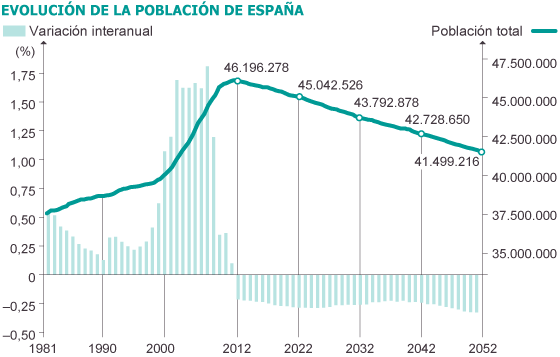
Fuente: Instituto Nacional de Estadística (INE). / EL PAIS
Spain's population will decline this year for the first time since at least 1971
In 2022, there will be 45 million people compared to more than 46 of today
Births are progressively reduced because there are fewer women of childbearing age
Andrew R. Gavino Madrid 19 NOV 2012 - 11:19 CET
Spain lost a tenth of its population in 40 years if current demographic trends hold. The fall will begin this year, when the number of inhabitants will decrease for the first time since at least 1971, according to data released this morning by the National Statistics Institute (INE). Births are progressively reduced, leading in 2022 to a total of 45 million inhabitants, compared to more than 46 million today. In 2052 the fall will be more pressing to diminish to 41.5 million.
The cause of the reduction in births is on the decline in cash of women of childbearing age, the crisis caused by the birth of the 80s and early 90s on the female population pyramid. Based on statistics released this morning, the number of births will not increase until 2030, but will go back down in 2040. In 2021, the estimate is at 375,159 births, 20% less than in the last year. Until 2031, would register 7.7 million births, 9% less than in the last 20 years. The average age of women having children will continue to rise from the current 31.5 years.
Life expectancy will maintain an upward trend. INE estimates suggest that in 2051 will reach 86.9 years for males and 90.7 years for women, which is a two-year reduction in the difference between the two. With downline births and life expectancy up, the result is a society with greater numbers of older people, ie more deaths per year. In the next 40 years, there will be 34% more deaths than during the previous 40.
More emigration to immigration
The net migration in 2012 will be negative. Facing the 376,696 immigrants who are expected, according to the latest information available, the output of Spanish to foreign countries is estimated at 558,175 people. In both cases, data are lower than 2011. The crisis is forcing many Spanish to seek work outside of Spain due to sluggish domestic market, whose employment bleeding has not stopped. In the medium term, when it is expected an improvement in the economy, fewer people will choose to leave Spain. Still, up to 5.2 million could do in the next ten years and 18.1 million until 2052.
Although the number of immigrants has decreased in 2012, the trend will be different in the coming years. The progressive increase that Spain will receive 3.9 million people in ten years and 16.7 million in 40 years. Most come from the European Union while South America and Africa will remain as the two other major points of origin.
In this situation, the dependency ratio will rise to 58% in ten years and reach extraordinary heights in 40 years to stand at 99.50%. Thus, in 2022 there will be ten people of working age for six partially inactive, ie under 16 years or over 64. The data is triggered in 2052 with a working-age person otherwise would not.
The south and the islands are the only territories with growth prospects. The Region of Murcia, Andalusia, Balearic and Canary are communities along the autonomous cities of Ceuta and Melilla, that gain population. The most pessimistic forecasts affect Galicia, Castilla y León, Asturias, Basque Country, Aragon, Extremadura, Cantabria and La Rioja, where the number of deaths and births overtake in a very short time, in the next ten years.
The INE statistics also details the expected net migration for the communities until 2021. Catalonia and Madrid are the two regions that suffer most progress toward foreign residents with a difference of more than 200,000 people over the Valencia-which is expected to be 176,027. Islands, Asturias, Aragon and Ceuta are the places where the average will be contrary and maintain a positive population balance. In terms of population from the rest of Spain, will be Madrid, Basque Country and Balearic the three communities that receive flow inhabitants.

0 件のコメント:
コメントを投稿