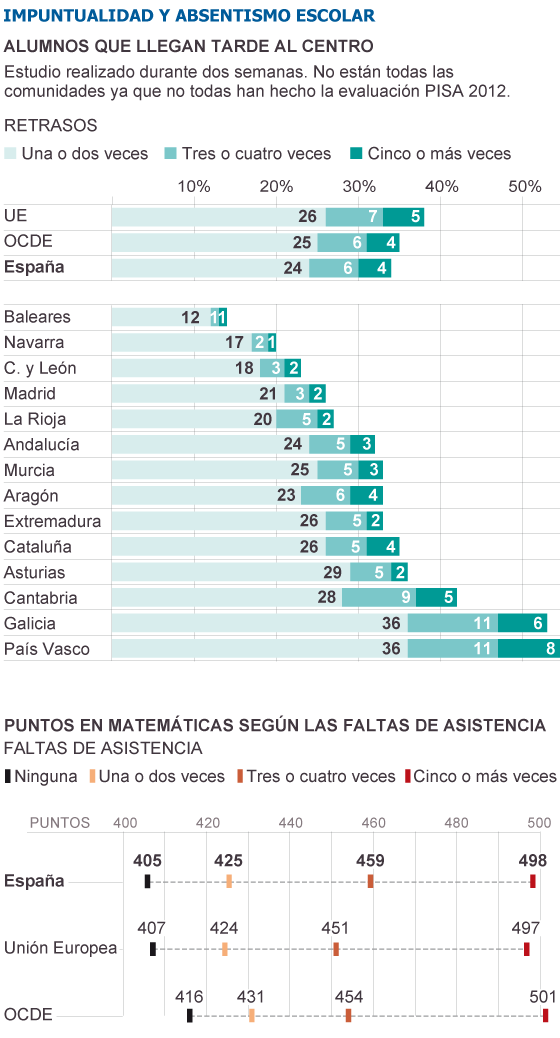
スペインでの学校の生徒の遅刻は、2週間につき、1/2回が24%、3/4回が6%、5回以上が4%. ズル休みは、2週間に付き、1/2回が28%、OECD諸国では15%。
La factura del absentismo escolar
El 28% de los alumnos falta a clase sin justificación al menos una vez cada 15 días
La tasa supone el doble que la media de la OCDE
Elisa Silió Madrid 9 FEB 2014 - 22:09 CET
The bill truancy
28% of students without justification truant at least once every 15 days
The rate is twice the OECD average
Elisa Madrid Silió 9 FEB 2014 - 22:09 CET
Spanish children are so punctual in class as the average of the countries of Organization for Economic Cooperation and Development (OECD ), but absentees . Almost twice . 28 % of 15 year olds reported having missed one or more days of unexcused class in the two weeks prior to the evaluation of the PISA tests , compared to an average of 15% in the OECD, as shown by the data the annual evaluation. Prune bill that absenteeism academic performance ? Undoubtedly yes, but there are more factors . In the PISA tests are observed up to 93 points - the equivalent of two full years of schooling - difference in math scores between half skip classes and those without.
This lack of classrooms negatively affects not only missed lessons , but because it denotes a complete lack of motivation, said Andreas Schleicher , head of the PISA report in Education Week XVIII of the Santillana Foundation. " The student asks, ' Why do I have to attend to that and I'm not doing other things ' is difficult to capture their interest when you open Internet windows everywhere ," he said at the conference sociologist Mariano Fernández- Enguita . This explains, in his opinion, they have raised rates of attention deficit hyperactivity disorder . " But it's almost impossible to leave school . Parents are angry , you lose a friend ... And without leave, absenteeism checked inside . Students are not to be, " he continued.
Tardiness , however , low five points in those nine years of PISA . In recent tests , 34 % of Spaniards said they had been late at least once in the past two weeks, the OECD average ( 35%). The difference in the math score is 47 points , more than one course , for those who are delayed at least half of the days.
Source: OECD / COUNTRY
Differences between regions are large. In the Basque Country and Galicia had come out of time 53% of the students in those pre- assessment of student skills two weeks OECD held every year , while in Balearic only did 17% . The incidence of tardiness in the PISA results is growing .
some figures
■ 24% of the Spanish school recognized in PISA tests have missed one or two days for the past two weeks , 3% , three or four days, and 1% , more than five.
■ At the ends of the OECD list as more unpunctual are Swedish , Portuguese and Israeli - over 50 % - delayed and most punctual as the Japanese ( 9% late).
■ A study of the La Caixa Foundation says that nine out of 10 dropouts in ESO are repeaters . Most also truants (226 hours of unexcused absences in the first cycle of ESO) .
■ The OECD estimates that 24.9 % of those over 16 years has left the education system with no more than lower secondary .
In humble and poor preparation , in which the expectations of parents' educational environments are not high - , tardiness or absenteeism is eight percentage points higher . Research indicates in fact that the children of unskilled workers have triple the risk of failure that university .
Schleicher , in its core document Strengths and weaknesses of the Spanish education, which appeared in Education Week Santillana , Spain regrets that managers are more permissive misbehavior - tardiness and absenteeism are termed minor offenses if non - repeated in the rest of the OECD. And , in more serious cases , the director of PISA underlines differences with the rest : "20% of Spaniards attending schools where the principal indicated that bullying affects learning , compared with 32% of the OECD."
To attract students to boring class Minister Jose Ignacio Wert calls "complicity to the educational community " in order to create in the Red " personalized learning environments " to suit the times. Absenteeism is very attached to repeaters . These missing 226 hours in junior ESO , according to the La Caixa Foundation. " Repetition is the delay of early detection of learning difficulties " reflected Wert in the conference .
Is consent in Spain too ? "I stay up late chatting with my friends and I stick the sheets ," says Andrea , 16 , a student at a public center of Madrid. " Although my mother hits me in a hurry, I'm late , but as a first time let me in ten minutes late ... sometimes up to 15" , follows the student, he started to fall behind when their parents left to take her class. Beside her, remembers the day that Antonio was not allowed to take an exam . "I came 10 minutes late and the teacher told me I was suspended, I had to learn to be on time , you can not be late for work ."
A major problem is that of absentee for long periods , a minority ( less than 1% ) but illegal practice: Schooling is compulsory until age 16 . In Madrid are about 4,000 chronically absent, of which more than half were Roma last year. A special attachment to the center is key for this group did not leave the room . So Madrid withdrew last year at his idea of closing a school gypsy strong presence : there was a risk that the new center not borrowed . In Andalusia , meanwhile , 16,000 children are in a program that seeks to curb absenteeism. "The problem is that it is a very rigid education system, which ejects people easily and collects troubles " concludes the former minister Mercedes Cabrera .

0 件のコメント:
コメントを投稿